คุณภาพอากาศภายในห้องเรียนมหาวิทยาลัย: การวิเคราะห์เชิงทฤษฎีกรณีศึกษาจังหวัดชลบุรี
Article Sidebar
Main Article Content
Abstract
Rotchana Prapainop
รับบทความ: 4 กันยายน 2568; แก้ไขบทความ: 27 ตุลาคม 2568; ยอมรับตีพิมพ์: 2 พฤศจิกายน 2568; ตีพิมพ์ออนไลน์: 30 ธันวาคม 2568
บทคัดย่อ
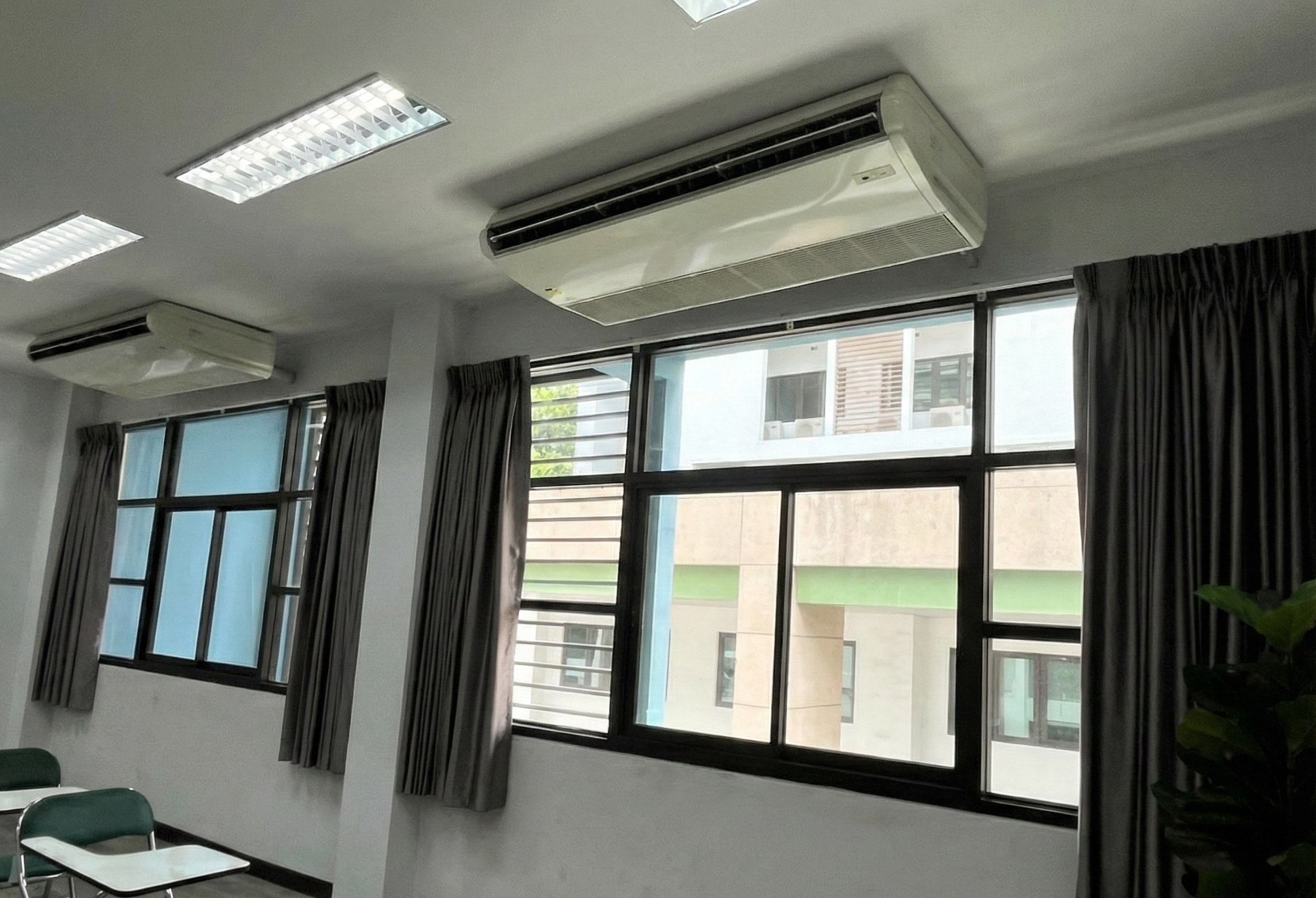
คุณภาพอากาศภายในอาคารสถานศึกษามีผลกระทบต่อประสิทธิภาพการเรียนรู้และสุขภาพของผู้ใช้อาคาร การศึกษานี้วิเคราะห์ความเข้มข้นของ PM2.5 และ CO2 ในห้องเรียนอุดมศึกษาจังหวัดชลบุรี โดยใช้แนวทางการจำลองทางคณิตศาสตร์เชิงทฤษฎี ห้องเรียนกรณีศึกษามีความจุสูงสุด 46 คน พื้นที่ 64 m2 ปริมาตร 185.6 m3 เป็นห้องปรับอากาศที่มีพัดลมระบายอากาศ ยังไม่มีระบบกรองอากาศหรือเครื่องฟอกอากาศ การศึกษาจำลองสถานการณ์ปัจจุบันและกรณีที่มีเครื่องฟอกอากาศ โดยใช้สมการสมดุลมวลในสภาวะคงตัว ผลการศึกษาพบว่าอัตราการแลกเปลี่ยนอากาศ 9.39 h–1 เพียงพอรักษาระดับ CO2 ไม่เกิน 1,000 ppm เมื่อใช้งานเต็มความจุ CO2 ในห้องคำนวณได้ 829 ppm (กรณีกำหนด CO2 ภายนอก 430 ppm) สำหรับ PM2.5 เมื่อไม่มีเครื่องฟอกอากาศ หากฝุ่น PM2.5 ภายนอกเท่ากับ 60 mg/m3 การคำนวณพบว่าภายในห้องจะมีฝุ่น PM2.5 เท่ากับ 47.49 mg/m3 การประเมินขนาดเครื่องฟอกอากาศเพื่อรักษาระดับ PM2.5 ภายในห้องให้ได้ 15 mg/m3 (เกณฑ์อากาศดีมาก) เมื่อฝุ่นภายนอก 30–70 mg/m3 จะต้องใช้ CADR 1,027– 4,745 m3/h หากต้องการควบคุมค่าฝุ่น PM2.5 ภายในห้องให้ได้ระดับที่ต่ำกว่า 25 mg/m3 (เกณฑ์อากาศดี) ต้องใช้ CADR 1,800 m3/h การเปรียบเทียบผลคำนวณกับการวัดจริงพบว่า I/O ratio ของ PM2.5 จากการคำนวณเท่ากับ 0.79 และจากการวัดแล้วปรับค่าเท่ากับ 0.75–0.79 (ห้องไม่มีเครื่องฟอกอากาศ) เมื่อ PM2.5 วัดได้ตั้งแต่ 4 mg/m3 ขึ้นไป แสดงให้เห็นความแม่นยำของแบบจำลอง แต่การปรับค่าที่ PM2.5 ต่ำกว่า 4 mg/m3 ยังไม่แม่นยำนัก ส่วน CO2 ความแม่นยำในการทำนายขึ้นกับการกำหนดค่า CO2 ภายนอก อัตราการระบายอากาศ และอัตราการผลิต CO2 ในห้องที่เหมาะสม ข้อจำกัดของการศึกษา คือ เป็นการศึกษาเชิงทฤษฎี สมมติพารามิเตอร์เป็นค่าคงที่ และศึกษาเฉพาะภาวะคงตัว การศึกษานี้สามารถใช้เป็นแนวทางในการทำนาย CO2 การประมาณขนาดเครื่องฟอกอากาศที่เหมาะสม และการทำนายระดับ PM2.5 ภายในห้องเรียนซึ่งเป็นประโยชน์ในการเลือกระบบฟอกอากาศสำหรับสถานศึกษาต่อไป
คำสำคัญ: ฝุ่นละอองขนาดไม่เกิน 2.5 ไมครอน คาร์บอนไดออกไซด์ ห้องเรียน การวิเคราะห์เชิงทฤษฎี คุณภาพอากาศภายใน
Abstract
Indoor air quality in educational buildings significantly impacts learning efficiency and occupant health. This study analyzes PM2.5 and CO2 concentrations in higher education classrooms in Chonburi Province using theoretical mathematical modeling approaches. The case study classroom has a maximum capacity of 46 occupants, floor area of 64 m2, volume of 185.6 m3, and is air–conditioned with exhaust fans but lacks air filtration or purification systems. The study simulates current conditions and scenarios with air purifiers using steady–state mass balance equations. Results indicate that an air exchange rate of 9.39 h–1 is sufficient to maintain CO2 levels below 1,000 ppm at full occupancy. Indoor CO2 concentration was calculated at 829 ppm (assuming outdoor CO2 of 430 ppm). For PM2.5 without air purification, when outdoor PM2.5 equals 60 mg/m3, calculations show indoor PM2.5 concentration of 47.49 mg/m3. Air purifier sizing assessment to maintain indoor PM2.5 at 15 mg/m3 (excellent air quality standard) with outdoor concentrations of 30–70 mg/m3 requires CADR of 1,027– 4,745 m3/h. To control indoor PM2.5 below 25 mg/m3 (good air quality standard), CADR of 1,800 m3/h is required. Comparison between calculated and measured with adjusted results shows PM2.5 I/O ratios of 0.79 (calculated) and 0.75–0.79 (measured and adjusted) for rooms without air purifiers when PM2.5 is equal or higher than 4 mg/m3, demonstrating model accuracy. However, for PM2.5 is smaller than 4 mg/m3, the accuracy of prediction is reduced. For CO2, prediction accuracy depends on appropriate assumptions of outdoor CO2 concentrations, ventilation rates, and indoor CO2 generation rates. Study limitations include theoretical approach, constant parameter assumptions, and steady–state conditions only. This study provides guidance for CO2 prediction, appropriate air purifier sizing estimation, and indoor PM2.5 level prediction in classrooms, which is beneficial for selecting air purification systems for educational institutions.
Keywords: Particulate matter 2.5, Carbon dioxide, Classroom, Theoretical analysis, Indoor air quality
Downloads
Article Details

This work is licensed under a Creative Commons Attribution-NonCommercial 4.0 International License.
References
AQ–SPEC. (2023). Field Evaluation Qingping – Air Monitor Lite. Air Quality Sensor Performance Evaluation Center. Retrieved from https://www.aqmd.gov/docs/default-source/aq-spec/field-evaluations/qingping---air-monitor-lite---field-evaluation.pdf? sfvrsn=12, August 13, 2025.
ASHRAE. (2022). ANSI/ASHRAE62.1 – Venti-lation and Acceptable Indoor Air Quality. Atlanta, GA: American Society of Heating, Refrigerating and Air–Conditioning Engineers (ASHRAE).
Chen, C., and Zhao, B. (2011). Review of relationship between indoor and outdoor particles: I/O ratio, infiltration factor and penetration factor. Atmospheric Environment 45(2): 275–288.
Department of Health. (2022). Ministry of Health Department Announcement on Indoor Air Quality Surveillance Standards for Public Buildings, B.E. 2565. Retrieved from https://laws.anamai.moph.go.th/th/practices/download/?did=211864&id=99012&reload=, August 13, 2025. (in Thai)
Han, S., Kang, J., Park, Y., Kim, J., Son, Y.–S., Kim, J.–J., and Choi, W. (2025). Contributions of ambient air, indoor activity, and an air purifier to classroom PM2.5 levels in three elementary schools. Building and Environment 272: 112674.
Keawmanee, V. (2019). Ventilation with IAQ of residential. Air Conditioning Engineering Association of Thailand (ACAT) News 22(79): 20–24. (in Thai)
Kim, J. H., and Yeo, M. S. (2020). Effect of flow rate and filter efficiency on indoor PM2.5 in ventilation and filtration control. Atmosphere 11(10): 1061.
Kim, S., Kang, K., Park, D., Na, H., and Kim, T. (2024). Balance point concentration: An indicator for classroom performance against outdoor PM2.5. Building and Environment 266: 112021.
Makaremi, N., Yildirim, S., Morgan, G. T., Touchie, M. F., Jakubiec, J. A., and Robin-son, J. B. (2024). Impact of classroom environment on student wellbeing in higher education: Review and future directions. Building and Environment 265: 111958.
Maneewattana, T. (2015). Calculations of Venilation Rate according to ASHRAE Standard 62.1, Vol. 20. Bangkok: Air Conditioning Engineering Association of Thailand (ACAT). (in Thai)
Maneewattana, T. (2019). Summarize the key points for protecting oneself from PM2.5. Air Conditioning Engineering Association of Thailand (ACAT) News 22(79): 26–33. (in Thai)
NASA. (2025). Carbon Dioxide. Retrieved from https://climate.nasa.gov/vital-signs/carbon-dioxide/?intent=121, July 24, 2025.
Persily, A., and de Jonge, L. (2017). Carbon dioxide generation rates for building occupants. Indoor Air 27(5): 868–879.
Pollution Control Department. (2023). Thailand Air Quality Index. Retrieved from https://ratchakitcha.soc.go.th/documents/140D157S0000000000300.pdf?fbclid=IwAR2bJGm_x9Df4ZBCOu-T9_RqDUdd27EhzGBL1jjhuU1lb-Wo6k6t4YKXsxM, August 14, 2025. (in Thai)
Pollution Control Department. (2025). Thailand Air Quality Statistics. Retrieved from http://air4thai.pcd.go.th/webV3/#/History, August 14, 2025. (in Thai)
Rackow, B., König, H.H., Wall, M., and Kon-nopka, C. (2025). The interaction between air pollution, weather conditions, and health risks: A systematic review. Science of the Total Environment 996: 180080.
Subcommittee for Promoting Clean Air Law Proposals. (2023). Principles of Draft Clean Air Law. Office of National Strategy and Reconciliation Reform Promotion. Retrieved from https://law.go.th/listening Detail?survey_id=MjgzOURHQV9MQVdfRlJPTlRFTkQ=, August 13, 2025. (in Thai)
Wang, M., Kim, R. Y., Kohonen–Corish, M. R. J., Chen, H., Donovan, C., and Oliver, B. G. (2025). Particulate matter air pollution as a cause of lung cancer: Epidemiological and experimental evidence. British Jour-nal of Cancer 132: 986–996.
Weisel, C. P., Zhang, J., Turpin, B. J., Morandi, M. T., Colome, S., Stock, T. H., et al. (2005). Research Report: Relationships of Indoor, Outdoor, and Personal Air (RIOPA). Part I. Collection Methods and Descriptive Analyses. Retrieved from https://www.healtheffects.org/system/files/RIOPA-I.pdf, August 15, 2025.
Wongpinijwattana, V. (2020). Ventilation Windows to Reduce Indoor Air Pollution in Classrooms. Bangkok: Thammasat University. Retrieved from https://ethesisarchive.library.tu.ac.th/thesis/2020/TU_2020_6216030103_13486_16440.pdf, August 15, 2025. (in Thai)
World Health Organization [WHO]. (2021). WHO Global Air Quality Guidelines. Particulate Matter (PM2.5 and PM10), Ozone, Nitrogen Dioxide, Sulfur Dioxide and Carbon Monoxide. Geneva: WHO.
Zhang, Y., Tao, S., Shen, H., and Ma, J. (2009). Inhalation exposure to ambient policyclic aromatic hydrocarbons and lung cancer risk of Chinese population. The Proceedings of the National Academy of Sciences USA 106 (50): 21063–21067.